If you’ve ever seen a trucker hat with a big, chunky leather patch sewn on the front, or a bucket hat with a big embroidered logo, then you’ve probably seen custom hat patches. They’ve quietly become one of the easiest ways to take a plain, off-the-shelf hat and turn it into something that really says who you are.
Whether it’s a small business owner building brand recognition, a football club kitting out supporters or someone who just wants a hat that nobody else on their street is wearing, we manufacture custom hats that make a difference.
This guide covers everything you need to know before you buy, from the different types of patches, to how pricing works, to where fashion is going, to the practical stuff (like how to put patches on without ruining your hat).
We’ll also touch on how to make custom hat patches yourself if you fancy a DIY approach, alongside the case for getting them made properly through a specialist like Eagle Patches UK.
What Exactly are Custom Hat Patches?
A custom hat patch is a decorative design and a symbol identity in some cases, that can be sewn onto the front, side, or back of a hat. It might be cotton, leather, PVC or something else.
It’s not printed directly onto the hat, but simply a patch that can be ironed on, sewed on, or secured with Velcro or hook-and-loop. This is the specialisation that Eagle Patches UK effectively offers.
This separation is really the clever bit. Since the patch is a little object in its own right, it can be made in bulk, swapped between different hats, embossed with texture, or built from materials that simply wouldn’t survive a direct print, like genuine leather or rubber.
That’s why you’re likely to see custom hat patches on everything from military-style caps to farmers’ market goods stalls to premium streetwear drops.
A Quick History Note
Patches have been around for decades, first worn on military uniforms and biker jackets to identify rank, regiment or club membership.
Hats were popular later and today custom trucker patches and custom cowboy patches are as recognised as anything you’d find on a denim jacket.
The Main Types of Custom Hat Patches
Each material acts differently, suits a different style of hat, and has its own price point. Here’s a breakdown of the most popular options on the UK market at the moment.
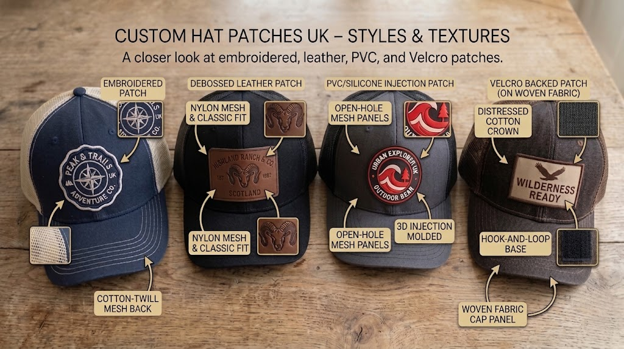
Custom Embroidered Hat Patches
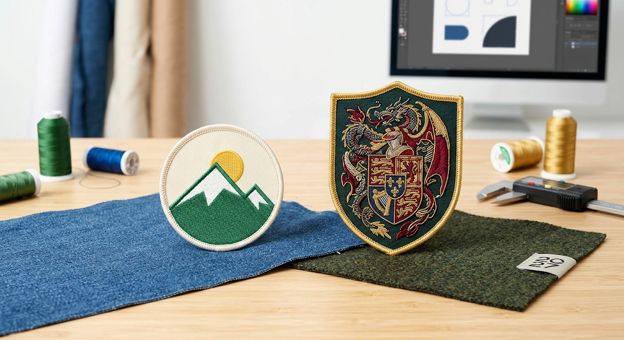
The classic pick, and for a good reason. Custom embroidered patches are a design in thread with dense stitching to create a raised, textured surface that feels superior to the touch.
They work well for logos, and anything with crisp lines. If you want personalized logo hat patches for a brand or team, embroidery is usually the first place to ponder upon.
Custom Leather Hat Patches
Leather hat patches (genuine or imitation) have been huge in the past several years, due to the whole “heritage workwear” and outdoorsy look that’s taken over menswear.
A custom leather hat patch usually laser-engraved (rather than embroidered with colour) provides a tough, vintage feel that’s particularly effective on trucker caps and cowboy hats. Custom leather cowboy hat patches have a really popular niche all their own.
Custom PVC Hat Patches
PVC (rubber style) patches are molded not sewn, thus they are waterproof, flexible, and great for outdoor/tactical gear. These custom PVC patches for outdoor use are becoming a growing choice.
Custom PVC hat patches and custom rubber hat patches are very much one and the same, and a favorite for tactical caps, hiking gear and anything that needs to endure rain, mud or a washing machine.
Custom Velcro Hat Patches
It’s all about flexibility with Velcro-backed (or “hook-and-loop”) patches and they’re not permanently sewed on, but attach and release in seconds.
Custom velcro hat patches are perfect if you want to change designs on the same hat. They are good for tactical caps, seasonal branding or anyone who can’t commit to one style.
Custom Iron On Hat Patches
If you want something quick and you don’t have a sewing machine, try custom iron on hat patches with heat activated adhesive backing. Follow the guide about how to iron a patch on a hat.
You can also press them with a household iron or heat press and they melt in seconds. They are a solid favorite for DIY projects and smaller personal orders.
Custom Sewn-On Hat Patches
If you want them to last longer than the convenience, then custom hat patches sewed on order online are the sturdier alternative.
The edge stitching permanently secures the patch and will last through years of use, washing and rough handling considerably better than iron-on adhesive alone.
Custom Hat Patches Specifications: What to Actually Decide on
When you want to order you’ll usually be prompted and interested to specify a few things. That’s what they all really signify for the final product.
| Specification | Typical Options | What it Affects |
| Material | Embroidery thread, leather, faux leather, PVC/rubber, woven, chenille | Texture, durability, weather resistance, overall look |
| Backing | Iron-on, sew-on, Velcro (hook & loop), self-adhesive | How it attaches and whether it can be removed or swapped |
| Shape | Round, oval, shield, custom die-cut | Fits the hat’s front panel or curved shape |
| Size | Usually 5cm–9cm wide for hat fronts | Visibility and proportion on the cap |
| Border | Merrowed (stitched edge), heat-cut, laser-cut | Neatness and fraying resistance |
| Colours | Unlimited with embroidery/PVC; limited with leather engraving | Brand accuracy and visual impact |
| Minimum order | No minimum to bulk (wholesale) | Cost per unit and turnaround time |
Getting these right upfront saves a lot of back-and-forth. A good UK patch maker, such as Eagle Patches UK, will typically send over a free digital mockup before production, so you can check the size, colours and placement look right before anything’s stitched.
Fashion Trends Driving the Custom Hat Patches Boom
Hat patches aren’t just a practical branding tool, they’re genuinely having a moment stylistically. A few trends worth knowing about:
- Heritage and workwear aesthetics continue to dominate, with leather hat patches custom-made to look”vintage”, or “aged” sitting perfectly on trucker and dad-cap silhouettes.
- Minimalist single-colour embroidery is replacing loud, busy logos, with small custom logo hat patches placed subtly rather than plastered across the whole crown.
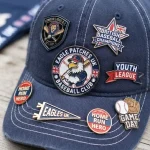
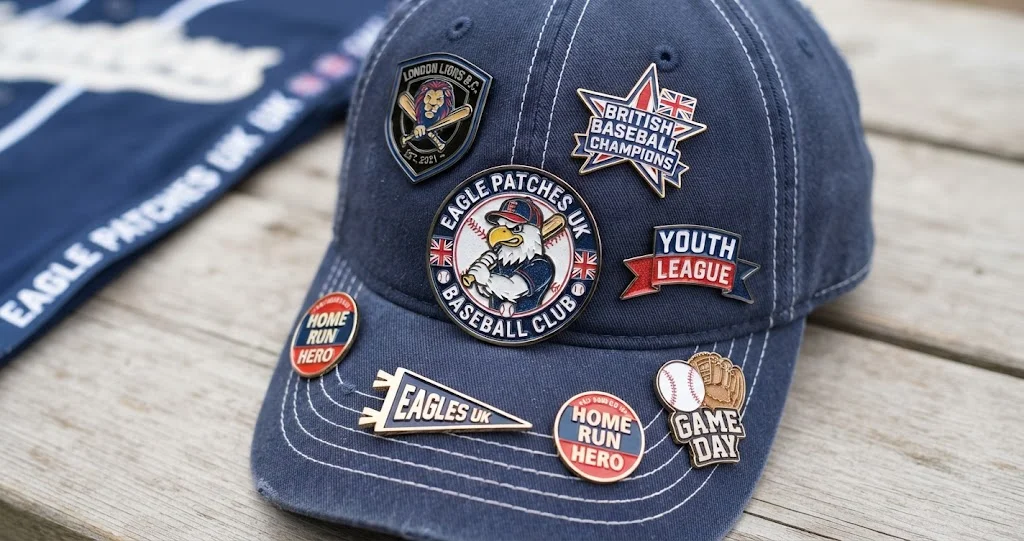
- Layered patch caps, multiple smaller patches on one hat, are showing up across streetwear and custom sports patches, echoing the biker-jacket patch culture of decades past.
- Sustainability-conscious materials, such as recycled thread and vegan leather alternatives, are increasingly requested for custom hat patches, particularly among younger buyers.
- Personalisation for gifting, from custom fitting hat patches for birthday caps to matching sets for hen and stag parties, has slowly emerged as an alternative to printed products.
- Tactical-inspired detailing, including custom tactical hat patches with Velcro backing, has crossed over from military and outdoor communities into everyday streetwear.
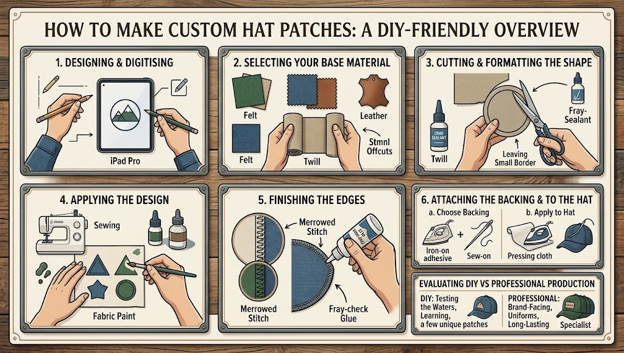
How to Make Custom Hat Patches: A DIY-Friendly Overview
If you’re curious about how to make custom hat patches yourself before committing to a professional order, here’s the general process, whether you’re prototyping a design or genuinely handcrafting one at home:
1. Designing and Digitising
Sketch or digitise your design. Keep the lines clean and avoid overly fine detail if you’re planning to embroider, as very thin lines can get lost in stitching. This also supports the services of embroidery digitisation.
2. Selecting Your Base Material
Choose your base material. Felt, twill, or leather offcuts can all work well for home projects. Twill is the beginner friendly option for stitching, or iron-on backing option for application.
3. Cutting and Formatting the Shape
Cut your shape, leaving a small border for stitching or heat-sealing the edges so it doesn’t fray.
4. Applying the Design
Add your design with hand stitching, a home embroidery machine, fabric paint or a heat transfer vinyl cutter for simpler shapes.
5. Finishing the Edges
Finish the edges with a merrowed stitch, zigzag stitch, or fray-check glue to stop unravelling.
6. Choosing and Securing the Backing
Attach a backing. Iron-on adhesive sheets are one of the simplest options for DIY projects, while sew-on offers greater durability.
7. Attaching the Patch to the Hat
Apply to the hat. For iron-on, use a pressing cloth and firm, even heat for 20–30 seconds. For sew-on, use a curved needle to work around the cap’s shaped panels.
8. Evaluating DIY vs Professional Production
DIY patches are wonderful for testing the waters, but for anything brand-facing, part of a uniform or meant to last, choosing a specialist patch manufacturer means consistent stitching, precise color matching, and high quality materials that hold up for a long time.
Accessibility and Ease: Practical Tips for Ordering and Wearing
Custom hat patches should be simple to order. A few tips to make the whole process easier:
- Ask for a free digital mockup before production, most reputable UK suppliers, including Eagle Patches UK, include this at no extra cost.
- Choose Velcro backing if you want to swap patches between many hats or seasons without having several caps.
- For workwear or uniforms, go with sew-on as iron-on adhesive might become loose with frequent washing.
- Search “custom hat patches near me” if you’d like to see physical samples first, though most UK-wide suppliers now handle everything remotely with digital proofs and free delivery.
- Order a small batch first if you’re testing a new design for a shop or event, this is far easier than it used to be thanks to no-minimum alternatives.
- Keep text minimal on smaller patches (under 6cm), as fine lettering can blur in embroidery at that scale.
- Ask about washing instructions, particularly for leather and PVC patches, which need slightly different care to embroidered ones.
- Check turnaround times if you are ordering for a specific event date, most UK makers offer roughly 7-10 working days after design approval.
Frequently Asked Questions
Are custom hat patches expensive to order in the UK?
Prices for embroidered patches can start from under £1 per unit at reasonable quantities.
Can I order just one or two custom hat patches?
Yes, Eagle Patches UK now offers custom hat patches, with “no minimum” for smaller personal orders.
What’s the most durable type of hat patch?
Sew-on patches, particularly PVC or leather, tend to outlast iron-on or adhesive-backed options.
Can I swap patches between different hats?
Yes, if they’re made with a Velcro (hook-and-loop) backing.
How long does a custom order typically take?
Mostly delivery time is within 7–10 working days, after you approve the design.
Can I see a preview before it’s made?
Yes, Eagle Patches UK provides a free digital mockup before production begins.
Can patches include gradients or multiple colours?
Yes, particularly with sublimated or PVC patches, which handle full-colour designs well.
Do I need a professional design file to order?
No, we offer free design support and can work from a rough sketch or idea.
Custom Hat Patches for Every Purpose
Whether it’s a custom hat with patches for a small clothing label, custom hat patches for an international order, or a single custom fitted hat patch as a gift, the appeal is the same, “a small, well-made detail that instantly upgrades a plain cap”.
Businesses use them for staff uniforms and merchandise, sports clubs use them for supporter gear, and individuals use them simply because a patch says more than a plain logo ever could.
For anyone in the UK looking to get started, working directly with a manufacturer who offers free design support, low minimums and fair pricing, Eagle Patches UK, takes the complexity out of the process entirely. You send over your idea, get a mockup to approve, and receive a finished product built to last.