Deciding between iron on patches vs sew on patches is perhaps the most frequent query we receive from our clients who are putting together their own collections of custom iron on patches or customising their jackets, jeans, and workwear.
Fans of each patch type exist, and both types can create a professional outcome with proper application.
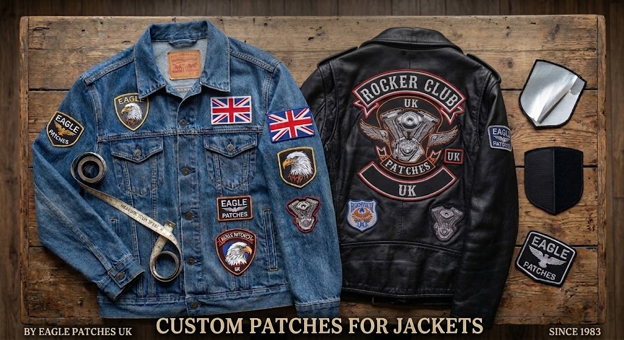
The decision must be made based on fabric type, permanence of the patch, cost incurred and time spent on patch application. Eagle Patches UK is a UK based custom patches manufacturer with iron on or sew on backing and can also provide Velcro and adhesive backings too if requested.
This blog will walk you through the differences in depth, guide you on how to attach patches properly, and also help you decide which backing type, iron on vs sew on patches, will be perfect for your project.
What Are Iron-On Patches?
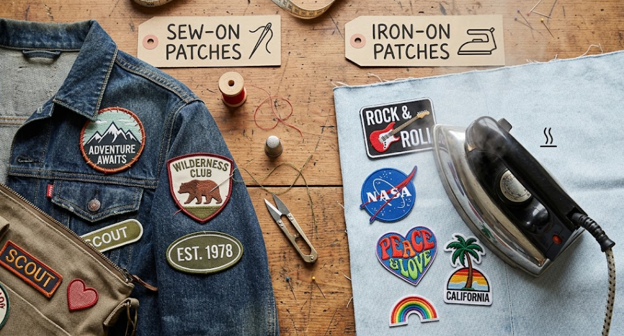
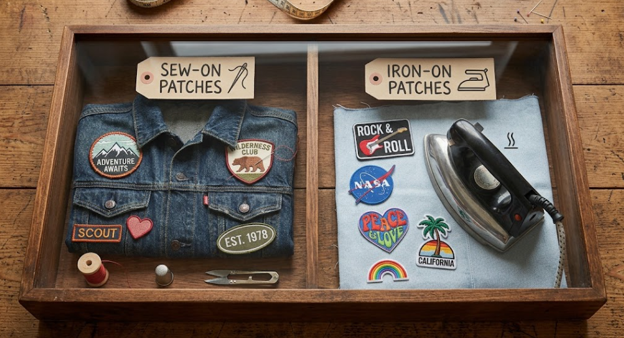
The iron on patch is made up of an adhesive layer which becomes activated by heat. The application of heat and pressure through either an iron or heat press leads to the melting of the adhesive layer, thus attaching it to the fabric on which the patch is placed.
It can thus be said that iron on patches are fast and convenient because no equipment is required to sew them on.
Iron on patches for clothes have become extremely popular with materials made of cotton and polyester blends, like t-shirts, jackets and caps.
They are capable of taking heat directly to the material. Iron-on patches are extremely common when it comes to making uniform patches, promotional patches, and even just a personal hobby since no sewing skills are required.
What Are Sew-On Patches?
The sew on patch consists of plain fabric material without any adhesive. It can be fixed through the use of a needle and thread through either sewing by hand or through the sewing machine. Sewing should be done around the border of the patch to fix it permanently.
Sew on patches for clothes are the best option when it comes to clothes that need to be washed, stretched, and worn often, like work clothes, biker jackets, and other outdoor clothing. Since the patch is sewn onto the cloth, it will last longer than an adhesive patch over time.
Iron-On vs Sew-On Patches: Key Differences
| Factor | Iron-On Patches | Sew-On Patches |
| Application method | Heat and pressure | Needle, thread, or machine |
| Speed | Minutes | Longer, depending on skill |
| Durability | Good for moderate use | Excellent for heavy or long-term use |
| Fabric compatibility | Best on cotton, polyester, denim | Suitable for almost any fabric |
| Reversibility | Difficult to remove cleanly | Can be unpicked and reused |
| Skill required | None | Basic sewing ability |
The iron on vs sew on comparison is the crux of the debate. An iron-on patch excels in ease and quickness of the attaching process, whereas a sew-on patch scores more points in terms of longevity.
The choice between iron on or sew on patches often comes down to one simple question for many of our clients: how often will this item need to be washed, or is it mostly for display?
Types of Patch Backing
Analysing patch backing options will help you find the right backing for your use. The top popular types of patch backing we provide include the following:
- Iron-on backing: A heat-activated adhesive film applied to the back of the patch.
- Sew-on backing: A plain twill or felt backing with no adhesive, ready for stitching.
- Hook and loop (Velcro) backing: A removable backing option often used on tactical or uniform garments with the flexible Velcro hook and loop panels.
- Adhesive peel-and-stick backing: A temporary option for short-term display, not recommended for regular wear.
- Iron-on and sew-on combined: Some patches are supplied with both, giving you flexibility to iron for a quick hold and stitch around the edge for permanence.
There is no single answer for queries like ‘Which is the best backing for patches?’ The best choice depends on the situation/usage.
A patch made for a child’s school jumper is better off with iron-on for speed. Meanwhile, a patch designed for a leather biker vest is almost always sewn on, since leather does not handle direct heat from an iron or a heat press quite well.
How to Iron On Patches
If you are looking for how to iron on patches, the process is simple and easy when you follow a few key steps.
- Preheat the iron to the cotton or wool setting, without steam.
- Position the patch on the fabric where you want it, adhesive side down.
- Cover the patch with a thin cotton cloth or pressing sheet to protect both the patch and the fabric.
- Apply firm, even pressure for twenty-five to thirty seconds, pressing rather than sliding the iron.
- Turn the garment inside out and press the reverse side for a further fifteen seconds to reinforce the bond.
- Allow the patch to cool completely before handling or wearing the garment.
Knowing how to iron on a patch correctly decreases the chance of having peeling edges, the main complaint people have regarding these patches. This also helps prevent damaging the patch or the fabric below.
As an added security measure, it is recommended to stitch around the edge after the adhesive cools down, especially in iron on patches for jeans due to the constant friction when moving.
How to Sew On Patches
For those asking how to sew on a patch, hand stitching gives the most control and works on fabrics that cannot tolerate heat.
- Pin the patch in place to hold it steady while you work.
- Thread a needle with strong polyester thread in a matching or contrasting colour.
- Stitch around the edge using a whip stitch or blanket stitch, keeping stitches close together.
- Knot the thread securely on the reverse side once you reach your starting point.
- Trim excess thread and check the patch lies flat against the fabric.
The zigzag stitch in the sewing machine will help make the task easy in case you have patches with straight edges.
Whatever choice you go for, ensure that you spend some time understanding how to attach patches properly. The outcome will be more satisfactory than just doing things in haste.
Iron-On Patches for Jeans and Denim
Denim is thick, durable and heat-resistant, making iron on patches for jeans an effective method, so long as the surface is flat and there are no thick seams in the vicinity.
The knees and hip areas of jeans go through considerable stress, and thus, it is best if one sews an iron-on patch along the perimeter of the patch for extra protection.
This method combines the fastness of ironing with the durability of sewing, and it is the method that we recommend using for most embroidered patches iron on or sew on decisions on clothing items that will be worn frequently.
Custom Patches: Iron-On or Sew-On?
When ordering custom patches iron on or sew on, the intended final use of the end product needs to be considered when selecting the backer.
Promotion items, event merchandise, and retail products will require an iron-on backing, as the end user will want something simple and easy to apply.
Items like uniforms and club patches that have to last many years will require a sew on backing or both as a combination.
At Eagle Patches UK, our expert team can advise on the correct backing for your specific fabric and use case.
We supply both options across our full range of sew on and iron on patches UK customers rely on for clubs, businesses, schools, and personal projects.
Which Is Better: Iron-On or Sew-On Patches?
It is not possible to provide one standard answer about which is better iron on or sew on patches, because everything comes down to the specific situation.
However, in situations when it is necessary to patch quickly and without any tools a heat-resistant material, custom iron on patches appear to be a great idea, especially for people who either do not know how to sew or do not want to spend too much time on that.
Iron on patches have special heat-activated glue on the backside, which makes them perfect for patching clothes such as jackets, uniforms or bags.
On the other hand, if you need a patch which is going to last for years when subjected to numerous washes and stretchings and even endure being worn out in the open air, then custom sew on patches is certainly the superior choice.
In terms of durability, sewn patches easily beat ironed ones because there is a solid link formed by the needle and thread which can withstand all sorts of hardships associated with daily life and frequent washes and open-air exposure.
Sew on patches are especially popular among people who have to wear patched clothing for a long time under tough conditions.
In addition to this, there are those customers who find that using the two backings together gives the best result: they iron the patch onto the material first and then stitch the patch edges after.
In such a way, they get all the advantages of both techniques, because the patch is not only fixed on the surface thanks to heat treatment but also stitched to make it stay firmly and not peel off later.
When choosing one of the two backings, a person may take into consideration the specific needs of his or her particular situation, which may vary from purely aesthetic to practical aspects or even a combination of the two.
Frequently Asked Questions
Can I iron on a patch and then sew it as well?
Yes. Ironing the patch ensures that it is held in position, making it much simpler to stitch around the edges than stitching an unattached patch on. This process is definitely one of the strongest methods of attaching patches to clothes.
Do iron-on patches work on leather or nylon jackets?
No, generally not. The leather or nylon may catch fire or may be damaged by the heat. It is best to use either sew on patches or hook-and-loop Velcro closures because they are safer alternatives as far as backing is concerned.
How long do iron-on patches last?
A well-applied iron-on patch can remain good for one or two years if washed properly before the glue starts fading. Stitching the sides will increase the lifespan greatly.
Is sewing on a patch difficult for beginners?
Not every time. All that is required is to make a few stitches along the edges of the patch. In case you feel that sewing is a difficult task, you can get help from friends and relatives who know how to sew or a tailor.
What is the best backing for a patch on a school uniform?
Iron-on backing is always considered more ideal for school uniforms due to its easy application at home, although a few stitches to reinforce the patch at the corners may help with durability during regular washes.
Buy The Right Backing For Your Next Project
Ultimately, the decision of whether to use iron on vs sew on patches will depend on the fabric being used, the intended purpose of the garment, and the amount of time available to apply the patches.
Iron-on patches are easier and quicker to use while sew-on patches are stronger and more durable. Combining iron-on patches with sew-on patches usually creates the most durable patches of all.
However, whichever method you choose, Eagle Patches UK provides quality embroidered and woven patches with the appropriate backing material for your needs.
Stop being confused when deciding between iron on patches vs sew on patches. Instead, contact us today to learn more about the custom patches and backing materials, or visit our website to shop our entire collection of products.