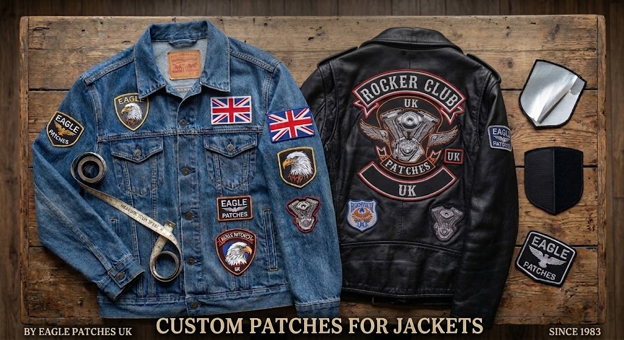
A well-made patch does something a printed logo rarely does. It signals permanence. Whether it sits on a staff jacket, a festival crew hoodie, a scout uniform or a limited-edition merch drop, a patch tells the wearer and everyone around them that the brand behind it takes craft seriously.
For UK businesses, that makes choosing the right custom patch far more than a design decision. It is a branding decision, a budget decision and, if you get the material or backing wrong, a very visible mistake.
This guide walks through every practical question a UK business owner, marketing manager or uniform coordinator asks before placing an order: which patch type suits the logo, which backing actually stays attached through a wash cycle, how MOQs and pricing work, and how long delivery realistically takes. By the end, you will know exactly what to specify when you request a quote.
Why Custom Patches Still Work for UK Businesses in 2026
Patches have outlasted almost every other promotional format because they are physical, durable and instantly recognisable as a mark of quality. Unlike a printed badge or a vinyl sticker, a stitched or moulded patch survives years of wear, washing and weather.
That durability is exactly why schools, cadet units, security firms, hospitality groups, motorcycle clubs and independent fashion labels across the UK keep coming back to them season after season.
Patches also carry a texture and dimension that a flat print cannot replicate, which is part of why british schools and cadet forces continue to favour embroidered badges over cheaper printed alternatives. For a business, that same texture reads as credibility.
A customer who sees a neatly stitched patch on a uniform assumes the company invests in details, and that assumption quietly builds trust before a single word is spoken.
Start With Your Goal, Not the Patch
The single biggest mistake businesses make is choosing a patch style before defining what the patch actually needs to do. Work backwards from the use case instead.
Staff Uniforms and Workwear
If the patch is going on jackets, polo shirts or hi-vis gear, it needs to survive commercial laundering and daily movement. Durability and a secure attachment matter more than novelty finishes here. Custom uniform patches are typically sewn or heat-sealed directly onto the garment for a permanent, tamper-resistant finish.
Events, Festivals and Limited Merch
For seasonal drops, festival crew kit or one-off event merchandise, cost per unit and a fast turnaround usually outweigh long-term durability. Iron-on or hook-and-loop backings work well because they let the same patch move between jackets, bags and caps.
Membership, Loyalty and Recognition
Clubs, associations and loyalty programmes often want a collectible feel. Velcro backings let members swap patches between kit, which keeps the design visible for longer and encourages people to collect the full set.
Product Branding and Retail
If the patch itself is the product, sold alongside apparel or as an accessory, finish quality becomes the whole story. This is where premium materials such as leather or chenille tend to justify a slightly higher unit price.
The Main Types of Custom Patches Compared
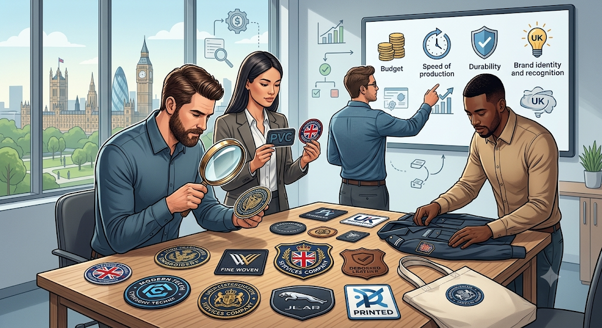
Once the use case is clear, the next decision is material. Each patch type has a distinct look, feel and price point, and the table below is a quick reference before you dig into the detail.
| Patch Type | Best For | Look & Feel | Relative Cost |
|---|---|---|---|
| Embroidered | Uniforms, schools, corporate branding | Classic raised thread texture | Low to mid |
| Woven | Detailed logos, small text, fine lines | Flat, sharp, high-resolution | Low to mid |
| Chenille | Varsity jackets, letterman styles | Thick, fuzzy, bold | Mid to high |
| PVC | Outdoor gear, tactical wear, uniforms | Rubberised, waterproof, glossy | Mid |
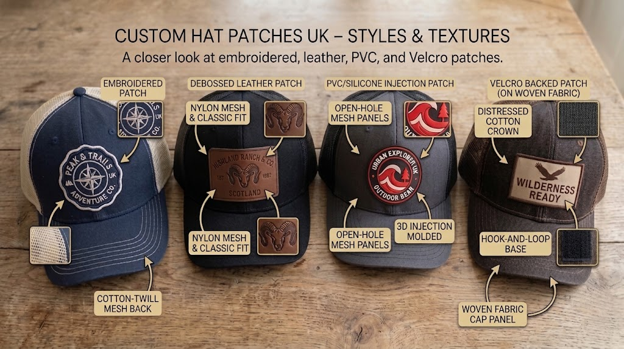
| Leather | Hats, denim, premium retail products | Vintage, tactile, upscale | Mid to high |
| Sublimated | Full-colour gradients and photo-style art | Printed fabric, unlimited colour | Low to mid |
| Applique | Layered, textured shapes | Raised fabric cut-outs with stitching | Mid |
| Sequin | Fashion, dance wear, novelty items | Reflective, reversible sparkle | Mid to high |
Which Patch Style Actually Suits Your Brand?
Table comparisons only get you so far. Here is how to think about each option in practice.
For most logos with clean lines and a moderate level of detail, custom embroidered patches remain the safest starting point. The raised thread gives a premium finish without pushing the budget, and it is the format most UK customers instinctively associate with quality uniforms and heritage branding.
If your artwork includes fine text, thin outlines or a photo-realistic level of detail, embroidery thread can round off sharp edges. This is exactly the trade-off covered in the comparison between embroidered and woven patches, and it is worth reading before finalising artwork if your logo has small lettering. In short, custom woven patches keep detail sharper because the design is woven flat rather than stitched in relief.
Streetwear, sports and collegiate-style brands lean toward custom chenille patches for their bold, tactile presence, while businesses that operate outdoors, from delivery fleets to security firms, often prefer custom PVC patches because the moulded rubber shrugs off rain and mud without cracking or fraying.
For a heritage or premium retail feel, particularly on caps and denim, custom leather patches add a tactile, upmarket finish that plain fabric cannot match. If your artwork is a full-colour illustration or gradient that would lose detail in thread, custom sublimated patches print the design directly onto fabric with no colour limit.
And for anything that needs a raised, sculptural shape, custom applique patches or custom sequin patches bring a layered, eye-catching finish suited to fashion-led brands.
Businesses weighing embroidered patches against a flat printed alternative should also see the direct comparison in custom embroidered patches versus printed patches for UK businesses, which breaks down cost, durability and perceived quality side by side.
Choosing the Right Backing and Attachment Method
The backing decides how the patch is worn and how long it lasts, and it is the detail most first-time buyers overlook. Choosing the wrong one is the fastest way to end up with a patch that peels, curls or falls off after a few washes.
| Backing Type | How It Attaches | Best Use Case |
|---|---|---|
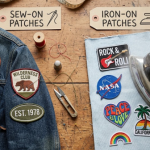
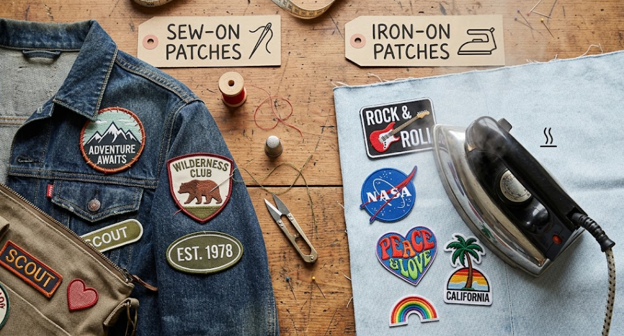
| Sew-on | Stitched through the fabric edge | Permanent uniform and workwear application |
| Iron-on | Heat-activated adhesive pressed on | Fast application on cotton or poly-blend fabric |
| Velcro (hook or loop) | Peels on and off repeatedly | Interchangeable kit, tactical gear, collectible sets |
| Adhesive backing | Peel-and-stick, no sewing or heat | Temporary or one-time promotional use |
| Safety pin | Pins directly to fabric | Events, name badges, short-term wear |
| Magnetic | Two magnets sandwich the fabric | Delicate fabrics that cannot be pierced or heated |
A useful rule of thumb: choose sew-on or iron-on for anything that goes through regular commercial washing, and reserve Velcro or adhesive backings for kit that changes hands often, such as festival crew jackets or trial uniforms handed out ahead of a full rollout.
For deeper detail on iron-on application, including which fabrics hold adhesive best, the guide on custom iron-on patches covers the full process and common application mistakes to avoid.
Size, Shape and Placement: Getting the Details Right
Patch size should follow the garment, not the logo. A chest patch on a polo shirt typically sits between 7 and 9 centimetres wide, while jacket back patches can run 20 centimetres or larger. Cap patches are usually kept under 8 centimetres to avoid crowding the front panel.
Shape matters more than most buyers expect. A circular or shield-shaped die-cut border reads as more premium than a plain rectangle, and it also hides stitching irregularities better on curved seams. If your logo already has an irregular outline, a custom die-cut shape that follows the logo edge, rather than a boxed border, will look far more intentional.
Colour, Thread Count and Logo Complexity
Most embroidery machines work cleanly with logos containing up to eight to ten thread colours. Beyond that, fine gradients and small text can blur together, which is why complex or photographic artwork is often better suited to sublimation or PVC rather than thread.
Before production starts, your artwork needs to be converted into a stitch file the embroidery machine can read. This is where embroidery digitizing comes in, translating your logo into stitch paths, densities and colour sequences so the finished patch matches the original design as closely as possible.
If your logo currently only exists as a low-resolution image or a photo, ask about vector conversion at the same time so the outline stays crisp at any size.
Budget, MOQ and Pricing for UK Businesses
Unit price drops sharply as order volume increases, so it pays to think about the next twelve months of stock rather than ordering the bare minimum every few weeks. Most UK patch makers set a low minimum order quantity specifically so small businesses and start-ups can test a design before committing to a bulk run.
Price is driven by four factors: patch size, number of thread or ink colours, backing type and order quantity. A simple two-colour embroidered patch at 500 units will always cost less per piece than a five-colour chenille patch at 50 units.
Turnaround Time and UK Delivery Expectations
Once artwork is approved, most custom patches UK orders are produced and delivered across the UK within seven to ten business days. Complex designs with multiple thread colours, unusual shapes or premium finishes such as leather or sequin can add a few extra days to the production stage, so it is worth building in a buffer if the patches are tied to an event date or a uniform launch.
Always ask for a digital mockup before production begins. A free preview catches sizing, colour or placement issues while they are still a five-minute fix rather than a reprint.
How to Choose a Reliable UK Custom Patch Maker
Not every supplier offering cheap patches online will deliver consistent stitching, accurate colour matching or a finish that survives repeated washing. Before placing an order, check for the following:
- A free digital mockup before production, so you can approve colours and placement first.
- Clear stated turnaround times, ideally with UK-based production or dispatch.
- A low minimum order quantity, so small businesses are not forced into oversized runs.
- A visible portfolio of finished work across multiple patch types and industries.
- Straightforward, itemised pricing rather than vague quote-on-request only listings.
It also helps to work with a supplier who produces the full range of custom patches for every occasion in-house, since that means your business can move between embroidered, woven, chenille or PVC across different products without switching suppliers or resetting quality expectations each time.
If your branding extends beyond patches, ask whether the same maker also produces custom lapel pins or offers DTF transfers for garments where a stitched patch is not practical, such as thin technical fabrics.
Common Mistakes UK Businesses Make When Ordering Patches
- Choosing a backing based on looks alone, then finding it fails after the first commercial wash.
- Sending a raster logo (JPG or PNG) instead of a vector file, which slows down digitizing and can shift colours.
- Underestimating small text, which blurs when embroidered below roughly 4 millimetres in height.
- Ordering the exact number of staff without allowing for replacements, new hires or spoiled patches.
- Skipping the digital mockup stage to save a day or two, then discovering a colour or size issue after production.
Frequently Asked Questions
What is the best type of custom patch for a small UK business?
For most small businesses, custom embroidered patches offer the best balance of cost, durability and a premium look, particularly for uniforms, aprons and jackets. If your logo has fine detail or small text, a woven patch will hold the design more accurately.
How many patches do I need to order as a minimum?
Minimum order quantities are typically kept low, often around ten pieces, specifically so start-ups and small teams can trial a design before ordering in bulk. Larger quantities reduce the price per unit significantly.
Which backing is best for staff uniforms?
Sew-on or iron-on backings are best for uniforms because they create a permanent bond that survives regular commercial washing. Velcro is better reserved for kit that changes hands or gets swapped between garments.
How long does it take to receive custom patches in the UK?
Most orders are produced and delivered within seven to ten business days after artwork approval, though more detailed designs or premium finishes can take slightly longer.
Can I see a proof before my patches are made?
Yes. A free digital mockup should be provided before production starts so you can review colours, sizing and placement and request changes at no extra cost.
What file format should I send for my logo?
A vector file, such as AI, EPS or a high-resolution PDF, gives the cleanest result. If you only have a JPG or PNG, ask about vector conversion so the outline stays sharp during digitizing.
Are custom patches better than printed badges for branding?
Patches generally outperform printed badges on perceived quality and longevity because the stitched or moulded texture reads as more premium and withstands wear far better than a flat print.
Can one supplier produce multiple patch types for different products?
Yes. Most established UK patch makers produce embroidered, woven, chenille, PVC, leather and sublimated patches from the same production line, which keeps quality and turnaround consistent across an entire product range.
Match the Patch to the Purpose
Choosing the right custom patch comes down to working through the decision in order: define the use case, pick the material that suits both the artwork and the wear conditions, select a backing that matches how the garment is actually used, and confirm pricing and turnaround before committing to a quantity.
Get those four choices right and the patch will do exactly what good branding is supposed to do, quietly reinforce trust every time someone sees it.
If you are ready to move from research to artwork, get in touch with the team for a free mockup and a straightforward quote based on your exact patch type, backing and quantity.