Cutting an embroidered patch cleanly is a skill every hobbyist, clothing brand, and DIY creator in the UK needs to get right. One rough cut ruins the border, frays the edge, and makes a quality patch look unfinished. The right technique turns raw embroidery into a retail-ready, professional result every single time.
Precision trimming protects the structural integrity of the patch border, keeps the merrowed edge intact, and gives your custom embroidery patches the clean, sharp finish they deserve. Whether you are trimming a single piece or finishing a full batch, the process stays the same, the right tools, the right technique, and no rushing.
Tools You Need for Precision Patch Trimming
The difference between a clean cut and a frayed edge almost always comes down to which tool you use. Using the wrong scissors on embroidery backing is one of the most common mistakes hobbyists and small brands make, and it shows immediately in the finished result.
Here are the tools that give you professional patch trimming results at home or in a small studio:
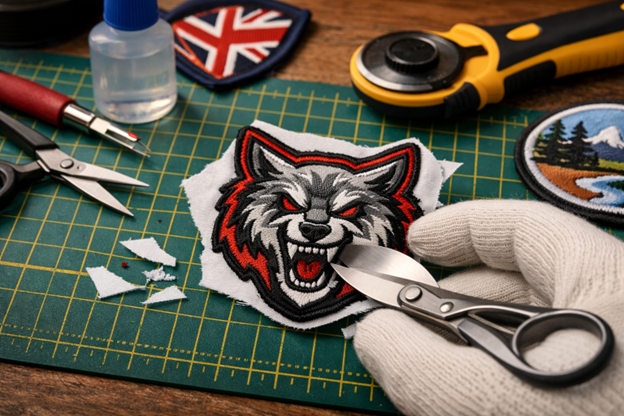
Duckbill Appliqué Scissors
These are the go-to tool for embroidery finishing work. The wide, flat lower blade slides under the excess backing fabric without catching the embroidery thread above it.
That separation between the backing and the stitched design lets you trim right up to the border stitch line without any risk of nicking the thread. For anyone trimming patches regularly, duckbill scissors are the single most important tool in the kit.
Fine-Tip Embroidery Scissors
Sharp, pointed, and short-bladed. These handle the detail work that duckbill scissors cannot reach, particularly tight curves, narrow corners, and any section of the border where the backing fabric sits very close to the design edge. The fine tip gives you control over exactly where each cut lands.
Rotary Cutter
Best suited to straight-edged patches and heavy-duty backings like thick felt, canvas, or stiff interfacing. A rotary cutter on a self-healing cutting mat moves through dense backing material in a single clean pass that scissors struggle to replicate on thick substrates. Less useful for curved or shaped patch outlines.
Self-Healing Cutting Mat
Essential when using a rotary cutter. Protects your work surface and keeps the backing flat and stable during cutting. The grid lines also help you align square and rectangular patches for perfectly straight cuts.
Fray Check Liquid
Not a cutting tool, but an essential finishing product for any cut edge that does not have a merrowed or heat-sealed border. A small amount of Fray Check applied to a raw cut edge seals the thread ends and backing fibres in place and prevents unravelling over time.
Step-by-Step: Cutting Excess Fabric from Custom Patches
Follow this sequence every time. Rushing any step risks the border and wastes the embroidery work already done.
- Secure Your Patch on a Flat Surface: Lay the patch face-up on a clean, flat work surface. Smooth out any curling at the edges. If the backing is stiff enough to hold flat on its own, proceed directly.
- Identify Your Cut Line: Look for the outermost border stitch line. You are trimming the excess backing fabric that sits outside this border, not cutting into the border itself. On a merrowed patch, the merrowed edge is the border.
- Use the Back-Side Cutting Technique: Flip the patch over so the backing faces up. This is the most important technique for clean patch edges. Cutting from the back lets you see exactly where the backing ends and the border stitch begins without the embroidery thread blocking your view.
- Handle Curves and Corners with Fine-Tip Scissors: Switch to your fine-tip embroidery scissors for any curved sections, tight corners, or sections where the border stitch sits very close to the backing edge.
- Check and Finish the Edge: Turn the patch face-up and inspect the full border under good light. Look for any remaining excess backing, any loose thread ends at cut points, and any sections where the cut ran too close to the border stitch.
How to Take Off an Embroidered Patch Without Damaging Fabric
Removing an iron-on or sewn patch from a jacket, hat, or bag without leaving damage behind takes patience and the right approach. Pulling a patch off cold and dry by hand is the fastest way to tear fabric fibres, leave adhesive residue, and create a visible mark that is harder to deal with than the patch removal itself.
For Iron-On Patches: Use Heat First
A hairdryer or a low-heat iron reactivates the thermoplastic adhesive that bonds the patch to the fabric. Hold a hairdryer on medium heat over the patch surface for 30 to 45 seconds until the backing feels warm to the touch.
The adhesive softens as it heats and releases its grip on the fabric fibres. While the patch is still warm, slide a flat, blunt tool, like a butter knife or a credit card edge, under one corner and lift slowly and evenly. Work around the perimeter rather than pulling from a single point.
For Sewn Patches: Use a Seam Ripper
A seam ripper is the only safe tool for lifting stitched patch edges from garment fabric. Slide the curved tip of the seam ripper under the border stitch on the back of the garment and lift individual stitches one at a time.
Work slowly around the full perimeter before attempting to lift the patch. Rushing and pulling at the patch before all stitches are lifted pulls fabric threads out of the garment weave and creates damage that no amount of steaming fixes.
Embroidered Patch Custom: Design Tips for Easy Finishing
| Design Principle | What to Do | Why It Matters (Impact on Trimming) |
| Add a Safety Border | Maintain 3–4 mm space between the design edge and cut line | Prevents cutting errors and gives room for scissors or laser tools to operate safely |
| Use Defined Border Stitch | Choose merrowed or satin-stitch edges | Acts as a natural cutting guide and stops fraying without extra finishing |
| Keep Edges Clean of Detail | Avoid placing fine embroidery near the perimeter | Reduces risk of damaging intricate elements during trimming |
| Simplify Outer Shape | Stick to circles, rectangles, shields, or basic crests | Makes hand-cutting faster, cleaner, and more accurate |
| Plan for Complex Shapes | Use laser cutting for intricate outlines | Ensures precision where hand trimming would struggle |
| Define Cut Line in Artwork | Mark cut line as a separate layer in production files | Eliminates confusion and prevents costly production mistakes |
FAQs
Does cutting a patch after it is made cause fraying?
Yes, if the border is not heat-sealed or merrowed. A raw cut edge on an embroidered patch without a defined border stitch will unravel over time as the thread ends work loose. Fray Check liquid applied to the cut edge seals the fibres in place and prevents unravelling.
Can I use a craft knife instead of scissors?
A craft knife works on a self-healing cutting mat for straight-edged patches with flat, stiff backings. It is not recommended for curved outlines, soft backings, or any patch where the cut line runs close to the embroidery border.
Is it easier to buy pre-cut patches?
Absolutely. Custom Patches UK uses laser cutting on every order, which delivers 100 percent uniform edges across the full batch with no manual trimming required. Laser cutting handles complex outlines, tight curves, and shaped borders with a precision that hand scissors cannot consistently replicate, and it removes the finishing labour entirely from your process.
Will taking off an embroidered patch leave a mark on my jacket?
It may leave a faint outline where the adhesive sat against the fabric. Steam the area with an iron on the steam setting immediately after removal to help the fabric fibres relax back into place.
Get Professional Results with Eagle Patches UK
Cutting, trimming, and finishing patches by hand takes time, the right tools, and a steady hand. Every Eagle Patches UK order arrives laser-cut, border-finished, and retail-ready, with no manual trimming work left for you to do.
Sharp edges, clean borders, and consistent uniformity across every patch in your batch, from a single piece to a full wholesale run. Get your free quote today and skip the scissors entirely.